How Obsidian.md changed my way of learning
When I was in High school I used to take notes with Microsoft Word. Since I was never fond of handwritten notes, it seemed to me like the best way of summarizing the books and the lectures I had to study. That was my main study plan: listen to the lecture, go home, put some notes on Word, filling the details on the book, trying to elaborate concepts and express them in my own words, and then ditch the book completely and study entirely on those notes.
I remember memorizing all the shortcuts to change a text from normal text to Heading 1, Heading 2, Paragraph, Bold, Italic etc... My pinky was hurting for how many times I was hitting that CTRL button.
Little I knew that Markdown was even a thing. Using characters to tell the computer how to format text? That was never even an idea I thought of, until it came the second year of my Bachelor's degree, when I was introduced to Notion.
Anyhow, when I switched to Notion everything changed. I discovered that it used a semi-Markdown syntax to format the text, and I also discovered that I could enter equations with a semi-latex syntax, and also pieces of code! It was amazing, the note-taking flow had never been this smooth, until I heard about Obsidian, around my second year of my Master's degree.
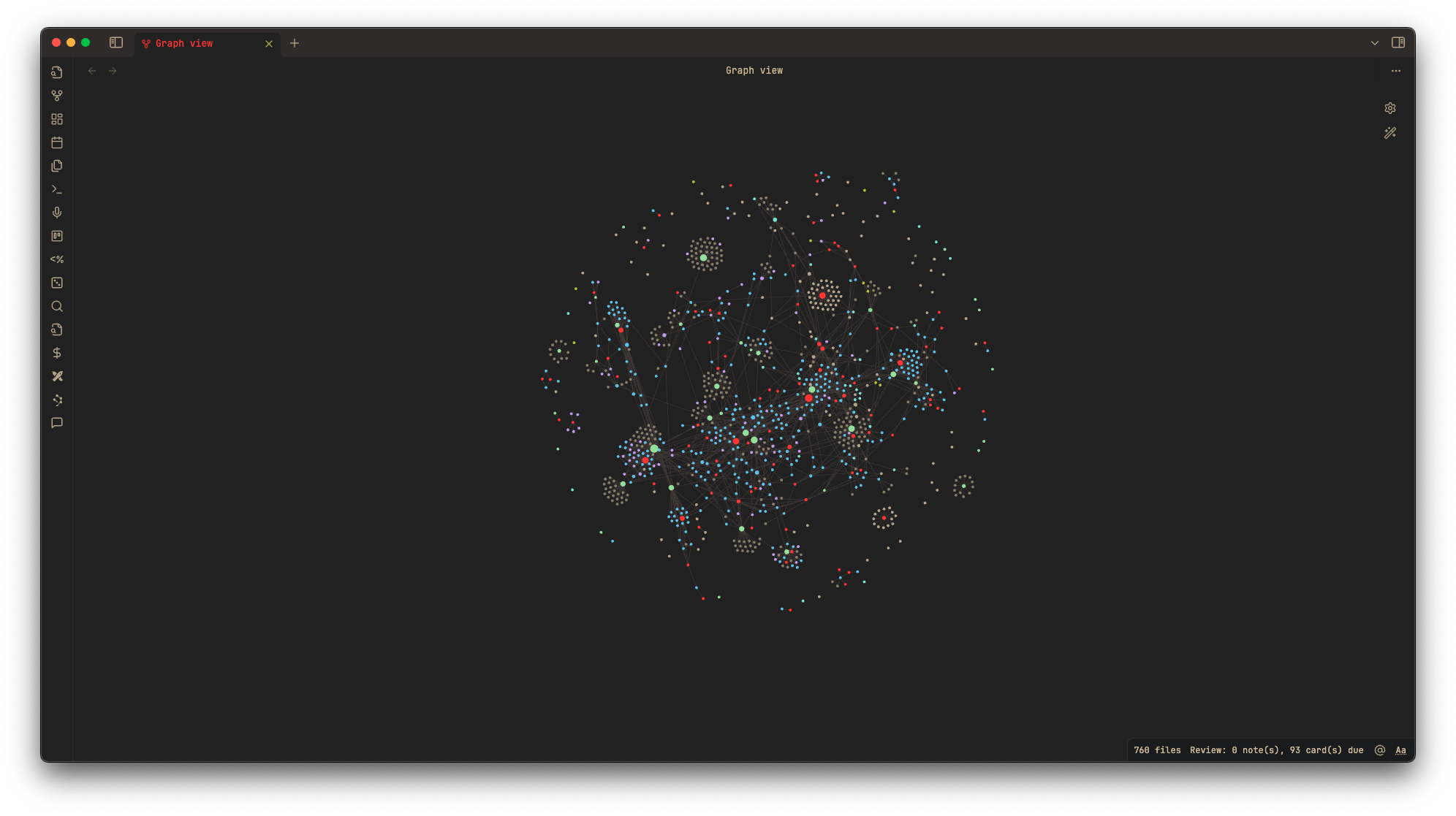
Most of the time Obsidian is advertised as a less bloated, faster and local alternative to Notion. In that period of time I was trying to be more interested in the privacy and ownership of my data, so the fact that the notes were just pure markdown files saved on my computer was the selling point that had me switching.
Wandering around on the internet, I stumbled upon the concept of Zettlekasten and a book called How to Take Smart Notes by Sönke Ahrens. That book, alongside the satisfaction of jumping around text using vim motions, changed the way I think probably forever.
The Philosophy of the Slip-Box
Zettlekasten can be translated into "Slip box". It consists into taking atomic notes, which usually include one concept, and then connect those atomic notes together via links. Overtime, this technique will create a nested web of concepts.
"If you sort by topic, you are faced with the dilemma of either adding more and more notes to one topic, which makes them increasingly hard to find, or adding more and more topics and subtopics to it, which only shifts the mess to another level."
The Zettlekasten taught me that notes are not linear, the way thinking is not a linear process. Why not adapt the note-taking process to how the brain actually stores information?
My Workflow
-
01
Literature Notes:
Summarizing papers (like "Attention is All You Need") directly connected to the source PDF. No external links here, just raw summary.
-
02
Fleeting Notes:
Drafting atomic concepts (e.g., "Self-Attention"). These are experimental and live in a dedicated folder while I refine the idea.
-
03
Permanent Notes:
Once a fleeting note makes sense, it's moved here and heavily linked to other concepts like "Transformers" or "RNNs".
If you're reading this, and you are still using Microsoft Word, Google Docs, or Notion—no hate. Everyone has their way of doing things. I'm just curious and open to new strategies on how to solve problems. Learning is ever-changing, and that's the beauty of it.