MLASS
Multi Latent Autoregressive Source Separation
This project extended the LASS method to support more than two sources while maintaining feasible memory complexity.
LASS: The Original Work
LASS separates mixed sources without needing additional gradient-based optimization. It uses a VQ-VAE to embed signals into a discretized latent space and autoregressive priors to sample original sources from a joint posterior.
MLASS: My Extension
I proposed two methods to decouple memory complexity from the number of sources ($n$), significantly optimizing the original $O(k^n)$ complexity.
-
01
Belief Propagation (BP):
Reduces memory complexity to $O((n-1)k^3)$, making multi-source separation viable on standard hardware.
-
02
Probabilistic Extractor (PE):
An alternative sampling approach for source separation in latent space.
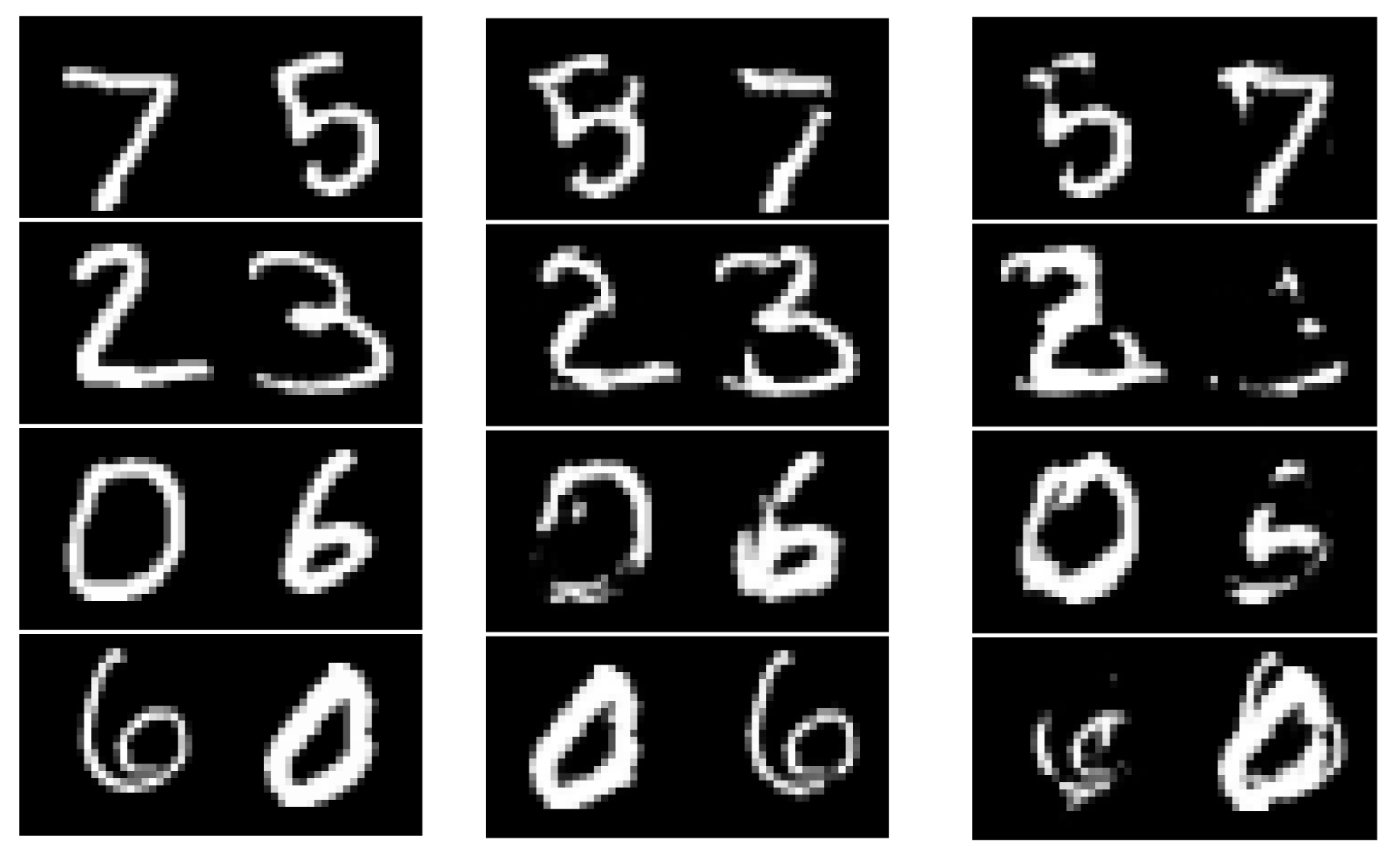
2 Sources: Original - BP - PE
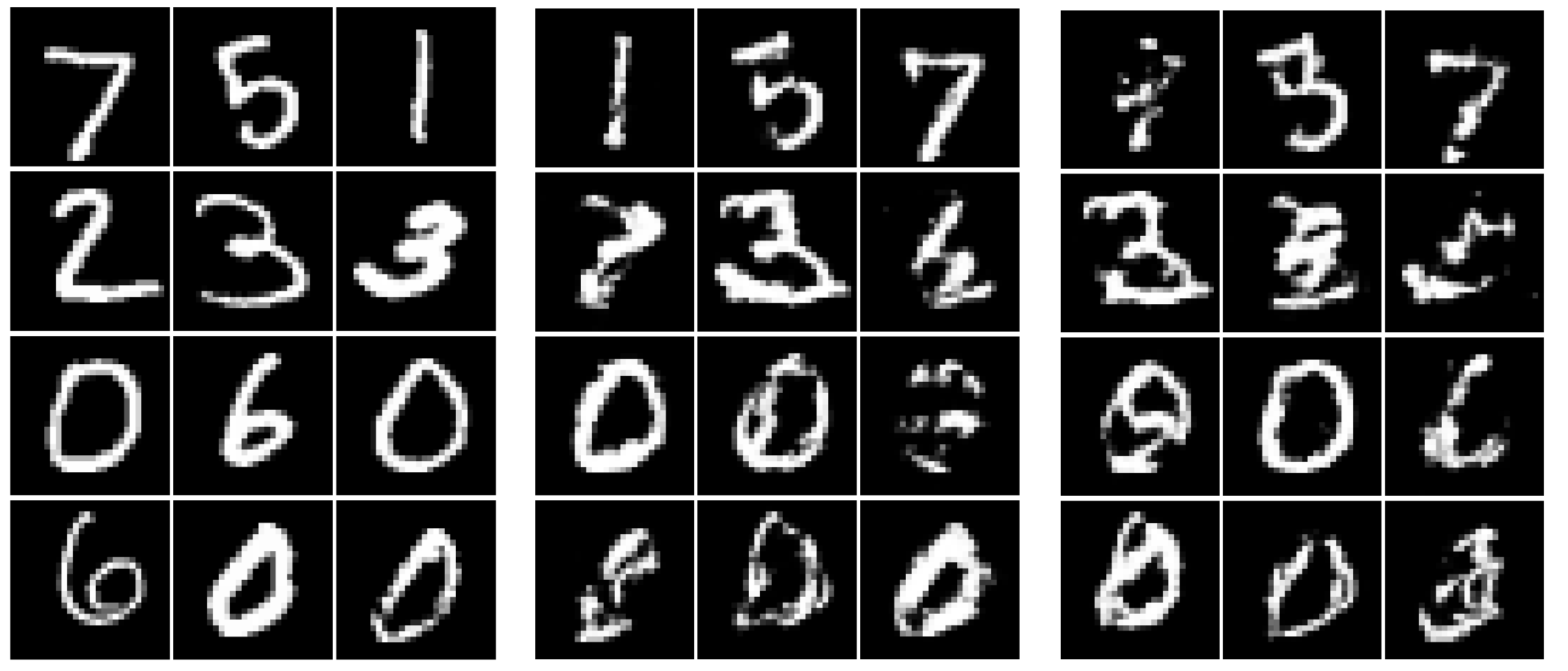
3 Sources: Original - BP - PE
Quantitative Benchmarks
MNIST Dataset (PSNR)
| Method | 2 Sources | 3 Sources |
|---|---|---|
| LASS | 24.23 ± 6.23 | N/A |
| MLASS-PE | 16.87 ± 3.77 | 13.64 ± 1.76 |
| MLASS-BP | 19.30 ± 5.68 | 14.19 ± 2.23 |
SLAKH Dataset (SDR)
| Method | 2 Sources | 3 Sources |
|---|---|---|
| LASS | 5.01 ± 2.39 | N/A |
| MLASS-BP | 3.09 ± 3.23 | -0.44 ± 2.96 |